
One Governance Program. Every Framework Covered.
AI regulations are multiplying. Trustible maps your governance program to 10+ frameworks simultaneously — so your teams document once and stay current as requirements evolve.
What Are AI Governance Frameworks?
AI governance frameworks are the regulations, standards, and guidelines that define how organizations should develop, deploy, and oversee AI systems responsibly. They come in two main forms.
Regulations are legally binding. The EU AI Act and Colorado SB 189 carry enforcement penalties and mandatory timelines. You don't choose whether to comply — you choose how to prove it.
Standards and voluntary frameworks like NIST AI RMF and ISO 42001 are adopted by choice, but increasingly expected. Enterprise customers, regulators, and investors treat them as evidence that your AI governance program is real, not just documented.
Regulations
Binding legal requirements with enforcement penalties. Compliance is mandatory for organizations in scope.
Standards
Certifiable management system standards from international bodies. Increasingly required by customers and regulators.
Voluntary Frameworks
Guidance from government agencies and coalitions. Referenced in procurement and enterprise risk programs.
Browse All Frameworks
Each framework page includes requirements detail, capability mapping, and a step-by-step implementation guide.
How We Map Frameworks
The Problem We're Solving
Most AI regulations share significant structural overlap — but organizations treat each one as a separate compliance track. Separate owners, separate documentation, separate audit trails for what is fundamentally the same governance activity.
Consider documenting human oversight mechanisms for an AI system. The EU AI Act requires it under Articles 14 and 22. NIST AI RMF references it across MAP-3.5, MEASURE-3.2, and MAP-2.2. ISO 42001 addresses it in Annex B sections B.3, B.4, and B.9. Without normalization, that's three separate tasks. With Trustible Controls, it's one.
How We Build Framework Mappings
Trustible's AI policy and regulatory experts read every framework in full — identifying every obligation, clause, and requirement. Requirements are normalized into Controls mapped to every article and clause they satisfy across all supported frameworks. Satisfy a control once, and your compliance posture updates across every applicable framework simultaneously.
Read the Framework
Every regulation and standard read in full by AI policy and legal experts.
Define Controls
Requirements normalized into structured Controls with guidance, questions, and evidence requirements.
Map Across Frameworks
Each Control mapped to every article and clause it satisfies — across all supported frameworks.
Scope to Use Cases
Designations and framework assignments auto-determine which controls apply to each AI system.
Satisfy Through Work
Controls satisfied through policies, workflows, documentation fields, or uploaded evidence.
Stay Current
As frameworks evolve, Trustible updates mappings. Your compliance work carries forward.
Not All Frameworks Are the Same
Trustible's AI policy and regulatory experts read every framework in full — identifying every obligation, clause, and requirement. Requirements are normalized into Controls mapped to every article and clause they satisfy across all supported frameworks. Satisfy a control once, and your compliance posture updates across every applicable framework simultaneously.
The Controls Architecture
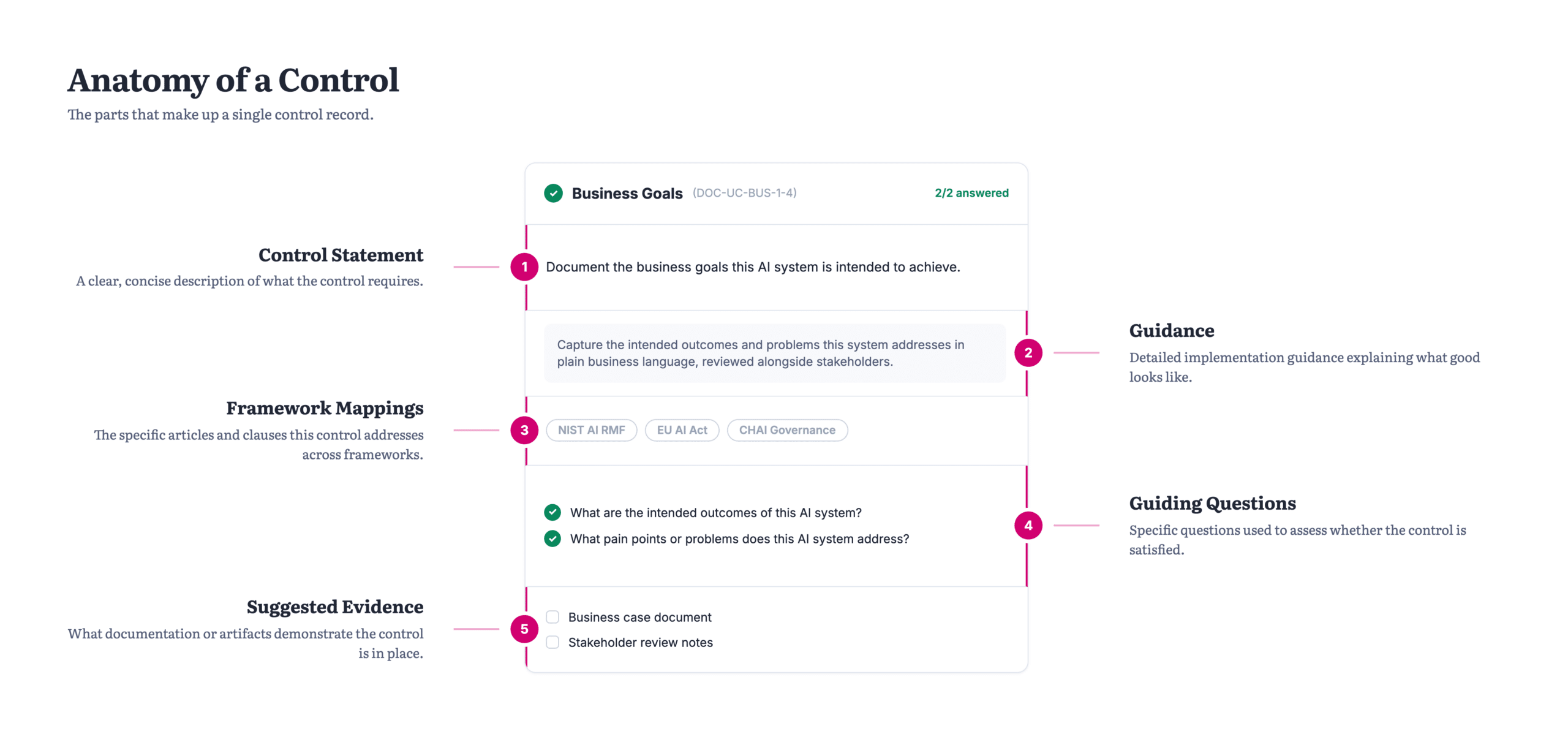
Controls are the operational core of Trustible's compliance architecture. Each Control is a normative statement about a specific action, documentation requirement, or process — mapped to every framework article it satisfies. Controls are organized hierarchically: parent controls describe a broad governance area; sub-controls break it into specific, assessable requirements.
Control Hierarchy Example
POL-AIP-1 — parent
The organization has an established AI policy covering key roles, responsibilities, and policies related to AI development and internal use of AI tools.
POL-AIP-1-1 — sub-control
The organization's AI policies clearly define relevant roles and responsibilities for building and governing AI systems.
Control Types
Designations: The Right Controls for Each Use Case
Not every control applies to every AI system. Designations are attributes assigned to a use case that reflect its regulatory classification. When you assign frameworks and designations, Trustible automatically determines which controls apply — so your teams see only what's relevant.
Surfaces the full set of EU AI Act documentation, technical, and oversight controls for systems classified as high-risk under Annex III.
Your organization placed this AI system on the market or put it into service. Provider obligations are more extensive than deployer obligations.
You're using an AI system built by another organization. A different, generally narrower, set of controls applies — though third-party accountability still does.
The system uses or is a general-purpose AI model. GPAI-specific controls apply under the EU AI Act from August 2025.
FAQs
Yes. Trustible maps a single governance program to 10+ frameworks at once, including the EU AI Act, NIST AI RMF, and ISO 42001. Instead of running separate compliance tracks for each regulation or standard, your team documents human oversight, risk assessments, and other requirements once through Trustible Controls. Each Control is pre-mapped to every article and clause it satisfies across all supported frameworks, so one piece of work updates your posture everywhere it applies.
It means the same underlying work counts toward every applicable framework, not just one. Trustible's policy and regulatory experts read each framework in full and normalize its requirements into Controls, structured statements mapped to every article and clause they satisfy. When your team satisfies a Control through a policy, workflow, documentation field, or uploaded evidence, that status updates across every framework the Control maps to. Document human oversight once, for example, and it can satisfy obligations under EU AI Act Articles 14 and 22, NIST AI RMF's MAP and MEASURE functions, and ISO 42001 Annex B at the same time.
Trustible's AI policy and regulatory experts continuously monitor framework changes and update Control mappings as regulations and standards evolve. Because your compliance work lives in Controls rather than framework-specific checklists, mapping updates carry forward automatically. Your teams don't re-document from scratch every time a regulator issues new guidance or a standard gets revised. This is the final step in Trustible's methodology: Stay Current.
Every Control includes guiding questions, framework mappings, and suggested evidence, tying compliance to specific documentation and artifacts. Designations assigned to each use case, such as High Risk, Provider, Deployer, or GPAI, determine exactly which controls apply, so audit-ready records reflect the regulatory exposure that matters for that use case. This is a core part of how Trustible helps teams prepare for an AI audit, with documentation auditors, customers, and regulators can review directly to see governance in practice.