


How to Build an Effective AI Governance Framework

An AI governance framework is the structured system of policies, processes, roles, and controls that guides how an organization develops, deploys, and oversees AI systems. It connects governance strategy to operational execution: intake workflows, risk assessments, compliance mappings, and audit trails. This piece is for the risk and compliance professional who has a mandate and […]
How to Prepare for an AI Audit in 9 Strategic Steps
Organizations that scramble to prepare for AI audits have the same underlying problem: governance was claimed, not built. This piece is for the compliance and risk professionals who want audit readiness to be a byproduct of their ongoing governance program, not a separate sprint. The structure is here. The documentation requirements are clear. What follows […]
5 Leading AI Governance Frameworks Every Organization Should Know

Most enterprise organizations don’t face one AI governance framework. They face several simultaneously, each with different requirements, different jurisdictions, and different documentation obligations. This piece is for the compliance and risk professionals who need to understand which frameworks apply to their organization and how to govern across all of them without building separate programs for […]
Should the EU “Stop the Clock” on the AI Act?
The European Union (EU) AI Act became effective in August 2024, after years of negotiations (and some drama). Since entering into force, the AI Act’s implementation has been somewhat bumpy. The initial set of obligations for general-purpose AI (GPAI) providers took effect in August 2025 but the voluntary Code of Practice faced multiple drafting delays. The finalized version was released with less than a month to go before GPAI providers needed to comply with the law.
What Does the Global Pause on AI Laws Mean for AI Governance?
The global AI regulatory landscape has taken a completely new direction in just one year. The US was previously leading the way on AI safety, attempting to work with like minded countries on building a responsible AI ecosystem. Yet since January 2025, the Trump Administration swiftly shifted the narrative by focusing on AI innovation and pausing […]
What is AI Monitoring?
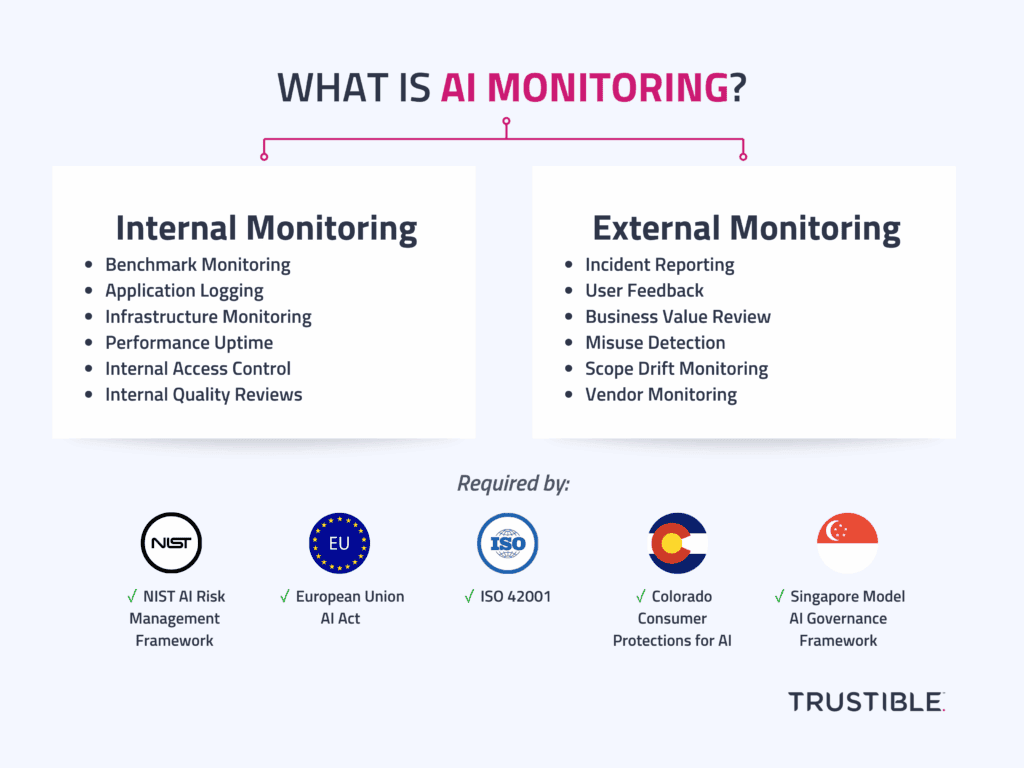
When many technical personas hear the term monitoring, they often think of internal monitoring of the AI system.
Analysis – How Trustible Helps Organizations Comply With The EU AI Act

The EU AI Act sets a global precedent in AI regulation, emphasizing human rights in AI development and implementation of AI systems. While the eventual law will directly apply to EU countries, its extraterritorial reach will impact global businesses in profound ways. Global businesses producing AI-related applications or services that either impact EU citizens or supply EU-based companies will be responsible for complying with the EU AI Act. Failure to comply with the Act can result in fines up to 7% of global turnover or €35m for major violations, with lower penalties for SMEs and startups.
Analysis – Mapping the Requirements of NIST AI RMF, ISO 42001, and the EU AI Act
Navigating the evolving and complex landscape for AI governance requirements can be a real challenge for organizations. Previously, Trustible created this comprehensive cheat sheet comparing three important compliance frameworks: the NIST AI Risk Management Framework, ISO 42001, and the EU AI Act. This easy to understand visual maps the similarities and differences between these frameworks, […]
CHEAT SHEET: Comparing EU AI Act, NIST AI RMF, and ISO 42001

Navigating the evolving and complex landscape for AI governance requirements can be a real challenge for organizations. We’ve created this comprehensive cheat sheet comparing three important compliance frameworks: the EU AI Act, the NIST AI Risk Management Framework, and ISO 42001. This easy to understand visual maps the similarities and differences between these frameworks, providing […]