


AI in hiring and workforce management has gone from an advantage to a standard. Job posts now draw hundreds or thousands of applications within a day, many AI-polished, and no team can sort that volume by hand. But not every AI tool used in HR carries the same risk. Risk comes from what a tool does, not which department owns it. Two questions orgs need to consider when determining risk: does it decide something about a person’s job, and how much is a human still contributing to that decision?
AI Created the Hiring Flood. Now It Has to Manage It.
Ask any recruiting team what changed in the last year and you’ll hear the same story. A job goes live and within 24 hours there are hundreds, sometimes thousands, of applications in the queue, many written or refined with AI. Sorting qualified from unqualified manually, at that volume, isn’t a staffing problem you solve with more recruiters. It’s a structural shift in how hiring works.
That’s why AI in HR has moved from innovative pilot to expected infrastructure. Applicant tracking systems triage resumes, interview tools transcribe and summarize, performance platforms flag patterns. The tools aren’t optional anymore, and neither is governing the risks that come with them.
Two AI Tools Can Sit in the Same Department and Land in Completely Different Risk Categories
A common assumption is that anything touching HR automatically comes back as high risk, but it is not so reductive. Risk is driven by what a system does and who it affects, not by which team owns it. There are two questions organizations should consider when determining risks and mitigations for their HR AI Systems:
Does it decide something about a person’s job? Hiring, promotion, pay, discipline, and termination outcomes carry direct, individual consequences. Tools that organize, extract fields, or transcribe don’t play a role in that decision, so they typically don’t carry that weight.
How is the AI contributing to the decision? If a person reviews the output before a decision gets made, the AI is informing the decision rather than making it. That lowers risk, but it doesn’t erase it. Under the EU AI Act, human review alone doesn’t count as an exemption.
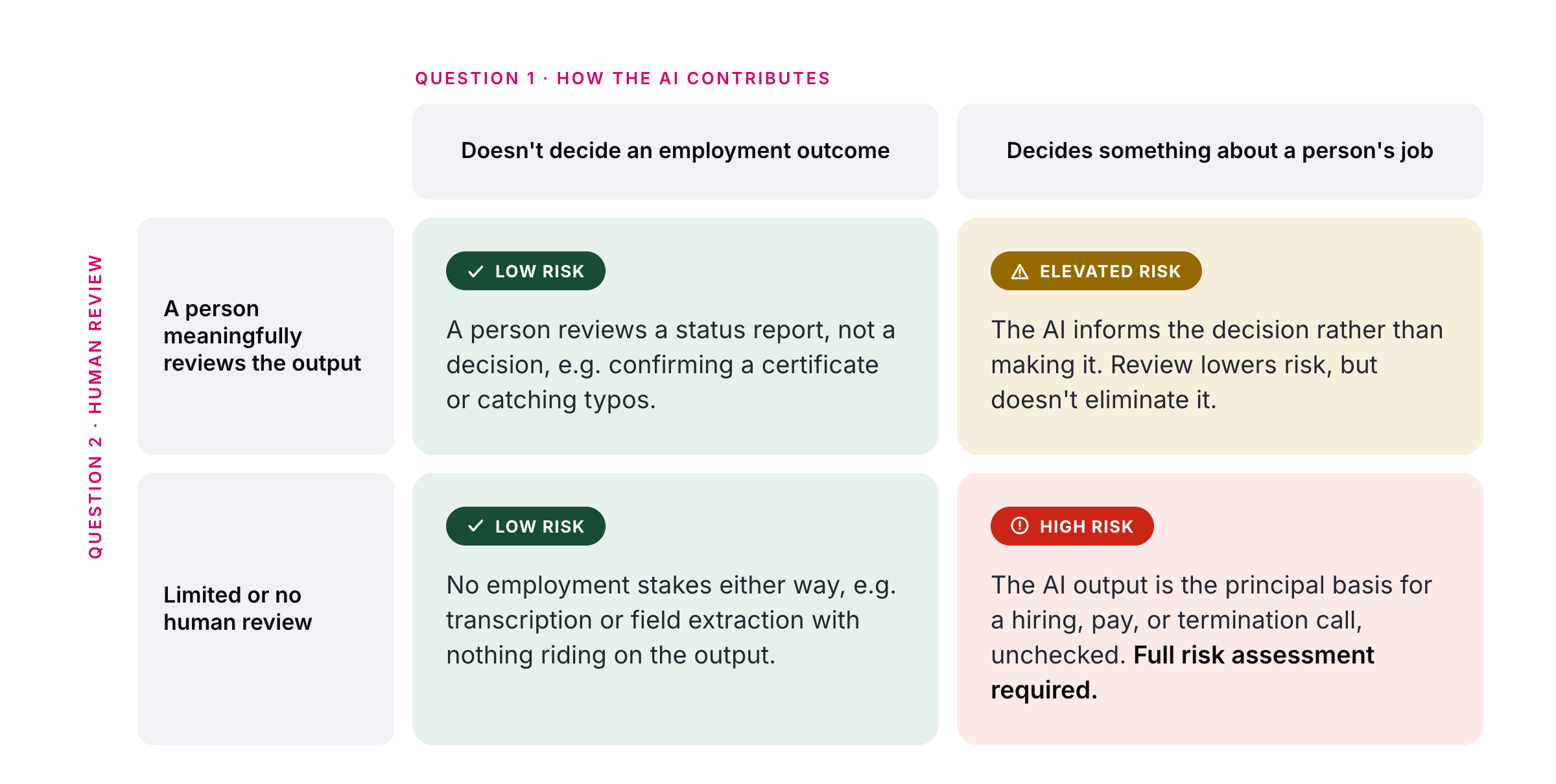
Risk in HR AI is a function of two questions, not one department label.
Score everything as high risk and governance teams drown in assessments for tools that never touch a hiring decision, slowing adoption of tools that are actually helping teams keep pace. Score things too loosely and a screening tool quietly filtering out qualified candidates over formatting mismatches, or reinforcing bias in who gets shortlisted, ships without the review it needed. That failure rarely requires bad intent. It just requires skipping the review step risk scoring is designed to trigger.
What the EU AI Act Says About Employment and HR
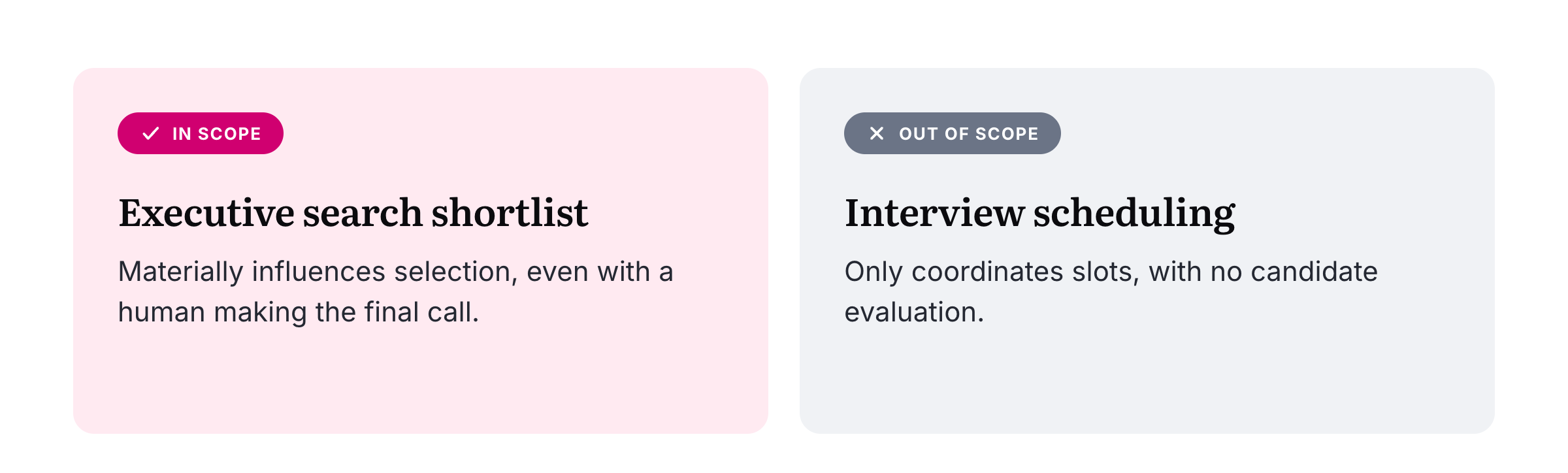
The EU AI Act’s Area 4 covers recruitment, selection, and ongoing workforce management. The EU AI Act seeks govern systems that shape access to work or affect workers’ rights. Recruitment and selection covers scoring, ranking, or shortlisting candidates; if a system is designed to filter candidates, it’s high-risk. Workforce management covers task allocation, pay and leave decisions, and performance monitoring that feeds evaluations, where the concern is power asymmetry and accountability. Self-employment and contracts extends the same logic to freelancers and platform workers; deactivations get treated the same as termination, and the contractual label doesn’t change the classification.
An executive search tool generating a ranked shortlist falls in scope even with a human making the final call, because it materially influences selection. A scheduling tool that only coordinates interview slots, with no candidate evaluation, falls outside scope.
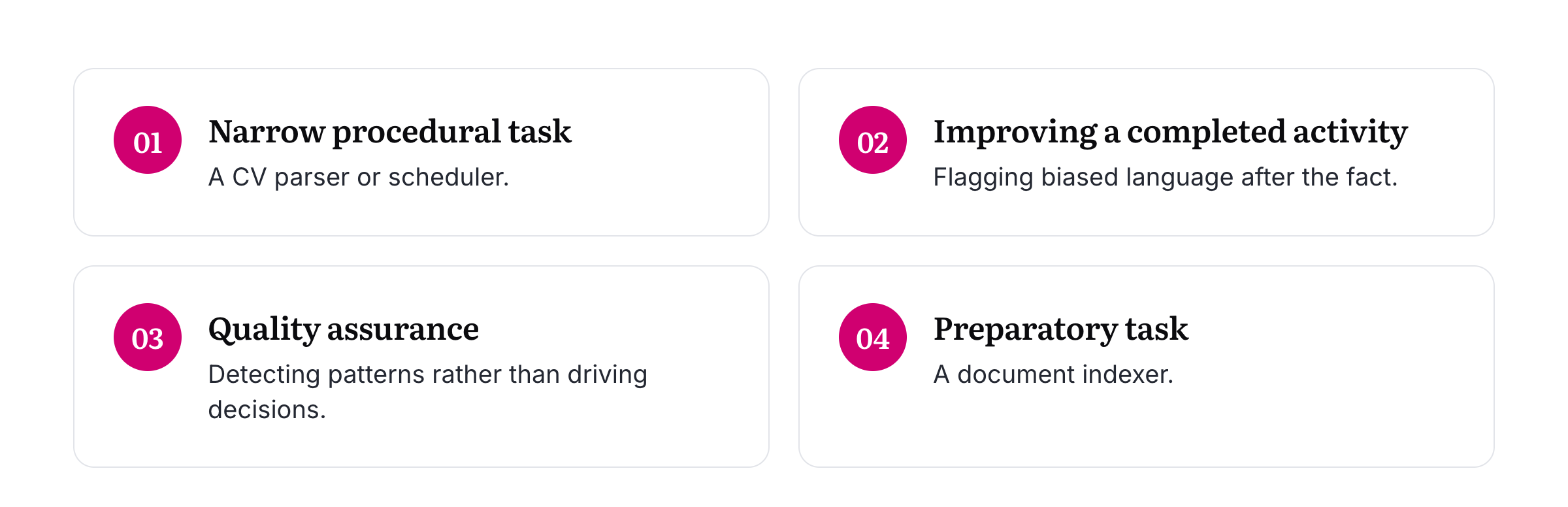
Even an in-scope system may avoid high-risk obligations under one of four Article 6(3) conditions, provided it doesn’t perform profiling:
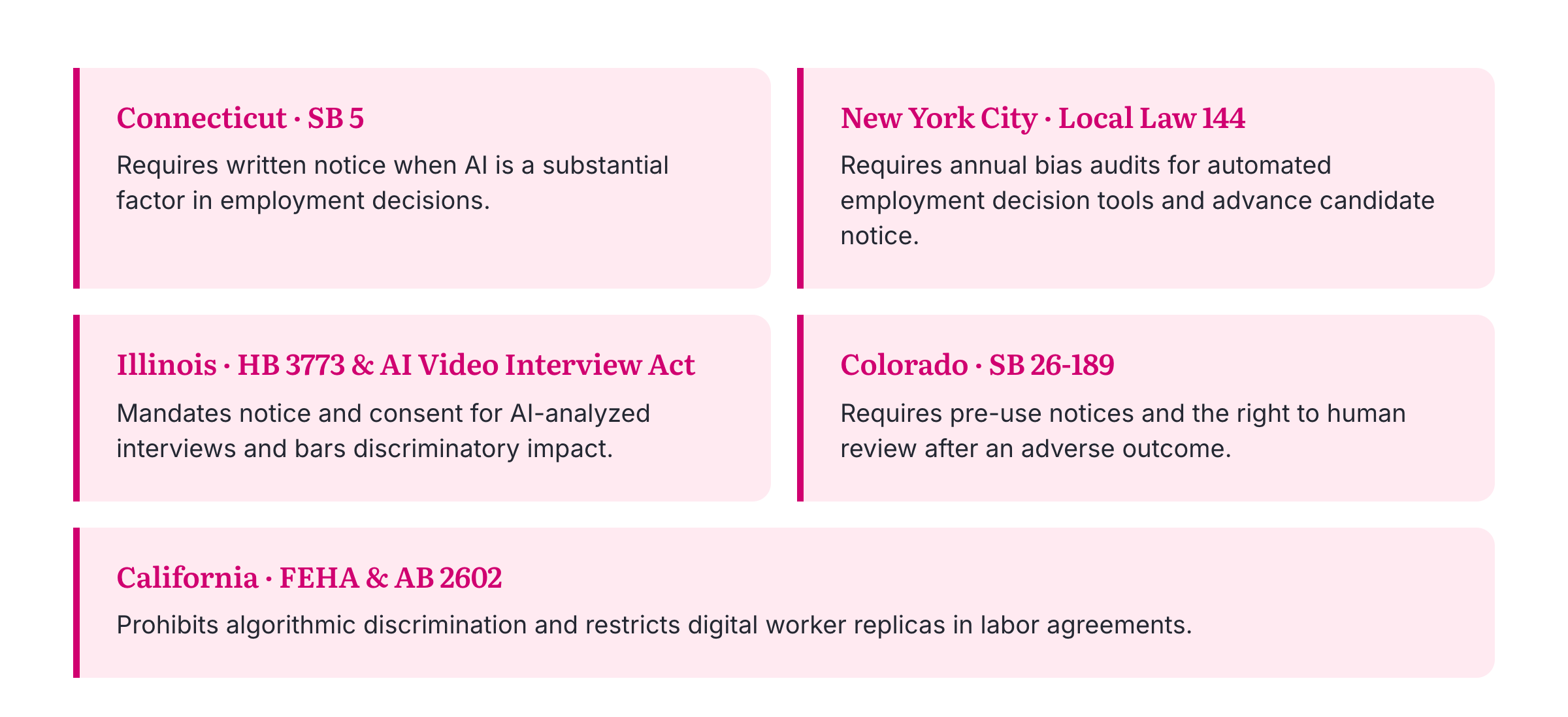
The US is Regulating State by State
As with other AI regulation, the states are not waiting for federal guidance to govern AI in employment. The pattern leans toward notice and transparency rather than outright bans, and that’s likely the direction US regulation keeps taking rather than a single risk-tiered framework like the EU’s.
The Takeaway for Governance Teams
Where risk starts: does the system decide something about employment, or just organize, track, or report information a person already has? That question sorts most use cases before you reach the second one.
The human checkpoint: does a person meaningfully stay in the loop before the output becomes a decision? Human review lowers risk, it doesn’t erase it, and regulators are increasingly explicit that a person looking at an output isn’t the same as evaluating it.
Different rulebooks, same rule of thumb: the US regulates through a patchwork of state and city laws, the EU through one risk-tiered framework. The mechanisms differ. The expectation for HR AI decisions to be documented, explainable, and human-reviewable remains.
Organizations that build this distinction into intake now, rather than treating every HR-adjacent tool as automatically fine or automatically risky, are the ones that will keep pace without walking into an audit they can’t explain.
If a platform is part of your resourcing conversation, Trustible is built specifically for this problem space, helping you centralizing your AI inventory, running intake and risk tiering, cross-stakeholder reviews, and reporting to help you demonstrate the value you are bringing to the organization.