Leidos and Trustible Launch Joint Initiative to Redefine AI Governance with Agents

Trustible and Leidos Logos

Collaboration applies proven AI principles to help automate governance, reduce friction, and support AI innovation and adoption across government missions. Arlington, Va. – FEB. 4, 2026 — AI governance is too often a brake on innovation. Trustible and Leidos (NYSE: LDOS) are working to change that. Today, the companies announced a partnership to redefine AI […]

A Pragmatic Blueprint for AI Regulation

An AI startup’s proposal for fair, pro-growth, pro-AI, non-partisan, AI regulation AI is one of the most transformative technologies of the century, with the potential to accelerate scientific research, improve healthcare outcomes, and help small businesses compete with larger enterprises. The United States currently leads the world in AI development. Yet despite this leadership, a […]

Trustible Leads Inaugural Sponsor Cohort for the AI Incident Database

Trustible, a leading provider of AI governance software for enterprises, today announced a partnership with the Responsible AI Collaborative (RAIC), the independent nonprofit behind the AI Incident Database (AIID). Trustible is leading RAIC’s inaugural cohort of corporate sponsors, and will integrate AIID incident data directly into its platform and collaborate with RAIC on research into […]

Everything You Need to Know About New York’s RAISE Act 

New York became the second state last year to enact a frontier model disclosure law when Governor Kathy Hochul signed the Responsible AI Safety and Education (RAISE) Act. The new law requires frontier model providers to disclose certain safety processes for their models and report certain safety incidents to state regulators, with many similarities to California’s slate of AI laws passed last fall. The RAISE Act will take effect on January 1, 2027. This article covers who must comply with the RAISE Act, what transparency obligations the law creates, and how the law will be enforced.

Everything You Need to Know About the Executive Order on a National AI Policy Framework (2025)

On December 11, 2025, President Trump signed an Executive Order directing the federal government to build a “minimally burdensome” national framework for AI and to push back against state AI laws the Administration views as harmful to innovation. The EO takes a new, novel approach via Executive Branch authority, creating an AI Litigation Task Force and asking the U.S. Department of Commerce to evaluate state AI laws and identify “onerous” laws (explicitly citing laws that require models to “alter their truthful outputs”.)

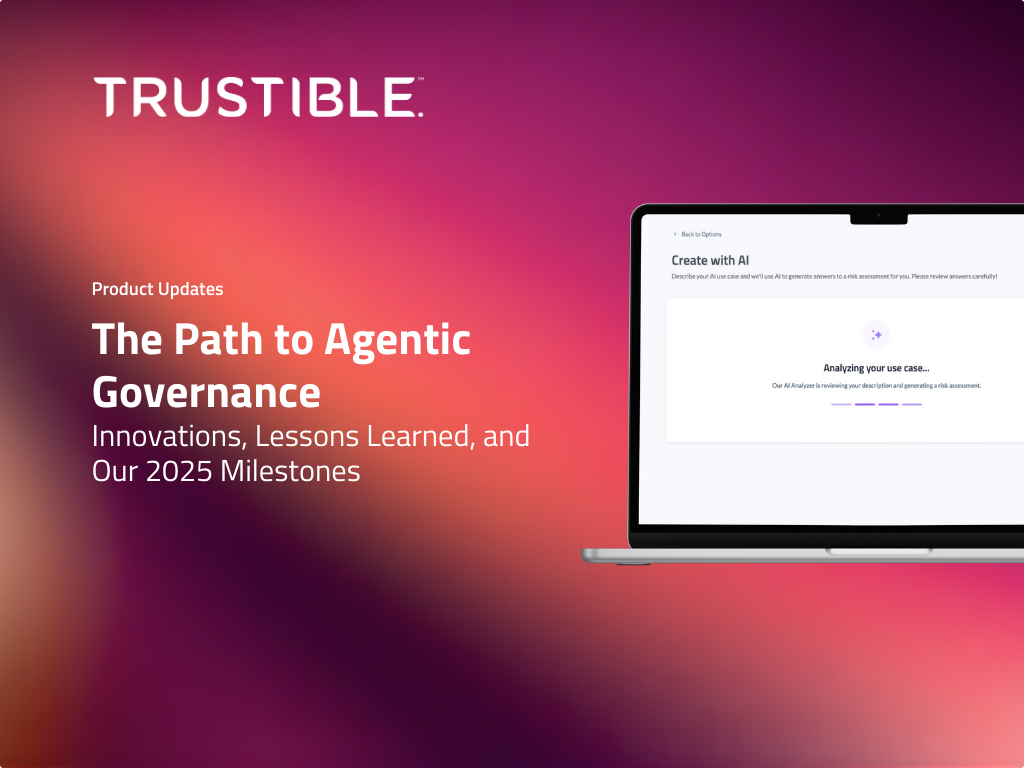
The Path to Agentic Governance: Innovations, Lessons Learned, and Our 2025 Milestones

In 2025, Trustible delivered the continuous, scalable programs needed for faster AI adoption at the same time that AI governance itself was shifting from principles and pilots to real production.
Our strengthened intelligence, collaboration, automation, and change management capabilities helped enterprises deploy AI deeper into workflows, decisions, and customer experiences.

5 AI Governance Trends Heading into 2026

AI has moved from experimental pilots to systems that shape real-world decisions, customer interactions, and mission outcomes. Organizations across sectors, including financial services, healthcare, insurance, retail, and the public sector, now depend on AI to run core operations and deliver better experiences. And their enthusiasm to adopt the technology responsibly is also growing. 

Shadow AI: What It Is, Why It Matters, and What To Do About It

Shadow AI has climbed to the top of many security and governance risk concerns, and for good reason. But the phrase itself is slippery: different teams use it to mean different things, and the detection tools being marketed as ‘Shadow AI detectors’ often only catch a narrow slice of the problem. That mismatch creates confusion for security and compliance teams, and business leaders who only want one thing: reduce data leakage, regulatory exposure, and business risk without strangling the organization’s ability to innovate.