


Key Summary: Every AI governance function starts from a different level of maturity and resourcing, but the sequence of decisions is similar: ground policy in real regulatory obligations, build a structure with clear (not just consultative) decision rights, centralize your AI inventory, make risk tiering explainable, prove the program’s value with data, and build the resourcing case from there.
No two AI governance functions start from the same place. Some leaders inherit a chartered committee, a dedicated budget, and a team of analysts. Others get a job title, a mandate to “figure out AI risk,” and not much else. The maturity, structure, and resources available to a new AI governance leader vary enormously by organization, and any checklist that assumes otherwise isn’t a useful one.
What doesn’t vary as much is the sequence of judgment calls. Whether you’re building a five-person function or doing this alone for now, the order in which you tackle policy, structure, inventory, risk classification, and resourcing follows a similar logic. This is a working checklist for roughly the first six months, organized by what has to happen before what, not by a rigid week-by-week calendar.
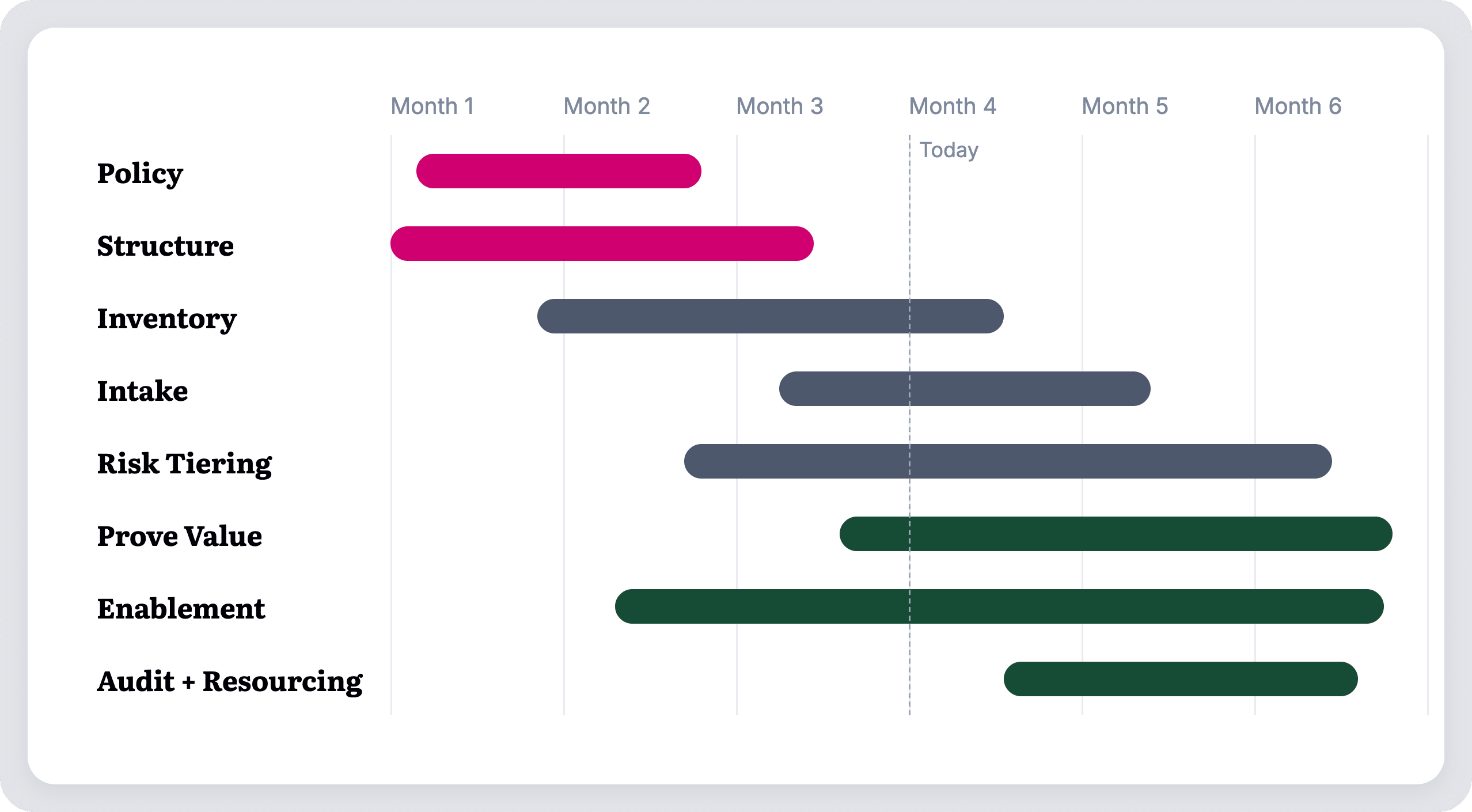
Get Your Policy and Regulatory Footing Right
Before you write a single policy, find out what your organization is actually required to do. Regulatory exposure varies enormously by industry: an insurer is managing state-level algorithmic underwriting rules, a bank has SR 11-7 and fair lending obligations to weigh, a hospital system is navigating FDA guidance and HIPAA’s intersection with AI, and a medical device company is looking at an entirely different set of premarket obligations. Figure out which of these apply to you specifically, rather than assuming the general AI governance conversation covers it. At minimum, get familiar with NIST AI RMF and ISO 42001 as baseline frameworks, and add the EU AI Act to that list if your organization operates in or serves customers in Europe.
With that grounding in place, putting a policy in writing becomes your first real deliverable, and it’s worth treating as the top priority because it dictates how everything else gets built. A useful AI policy covers two things: how the organization manages AI risk (what gets reviewed, by whom, under what conditions) and how employees are expected to use AI responsibly in their day-to-day work. Writing the policy is the easy part. The harder part, and the part that’s often skipped, is making sure it actually reaches people: communicate it clearly, distribute it through the channels employees actually use, and require documented acknowledgment. A policy that lives in a folder nobody opens isn’t a policy. It’s a liability.
Build a Governance Structure People Actually Engage With
Once you know your obligations and have something in writing, you need people and a process. Start with an AI governance committee, but be deliberate about what kind of committee it is. AI risk touches IT, legal, security, privacy, risk, the business units proposing use cases, and the technical teams building them, and no single person has full visibility into all of it. Pulling those stakeholders into a room on a regular cadence surfaces risks and blind spots that a governance function working in isolation would miss.
However, Committees are slow by nature, and if you hand them decision-making authority over individual use cases, you’ll bottleneck the exact process you’re trying to build. Treat the committee as a feedback and advisory body, not a decision-making one. Risk acceptance decisions should sit with AI governance directly, or with another clearly accountable owner, not with a room that has to reach consensus every time.
Alongside the committee, define the actual structure of the function: what the AI governance team is responsible for, how a business unit proposes a new use case, what evidence of mitigation is required before a higher-risk use case gets approved, and, critically, when governance gets involved. The earlier you’re brought in, the better, ideally at the idea stage rather than right before a production launch. Early involvement does two things at once: it catches risk before it’s built into a system that’s hard to unwind, and it gives you the chance to help the use case succeed instead of just checking it at the finish line.
Build the Inventory
Somewhere alongside your committee and structure work, start consolidating an inventory of every AI system your organization touches, in one place. This is broader than most people initially plan for. Include use cases that were proposed but never adopted, ones that quietly went into production without governance ever seeing them, and the agents, models, and third-party vendors that power all of it. If your organization has been experimenting with AI for more than a year, you’ll find more than you expect, and probably more than you’d like.
The inventory becomes the foundation for everything downstream: risk assessments, impact assessments, vendor reviews, compliance reporting. It’s worth getting the scope right early rather than adding categories later. For each use case, you should have clear ownership, status, and review history information written down, even if the use case documentation itself is thin at first. A sparse inventory you can build on beats a complete one you never finish.
Build an Intake Process People Actually Want to Use
With the inventory started, you need a live intake process for capturing new use cases as they come in, not just cataloging the ones that already exist. This is where most governance functions either win the organization over or lose it. Make it simple to engage: a general questionnaire that asks the right set of questions to determine risk and required reviews, or, better, a conversational AI that helps the person submitting the use case understand how to answer questions they might not know how to answer on their own.
Design the intake to be conditional rather than static. If someone indicates their use case involves personal data, the next question should ask what kind of personal data, not treat “yes” as the end of the inquiry. Branching logic like this keeps the form short for low-risk use cases and appropriately thorough for higher-risk ones, instead of asking everyone the same twenty questions regardless of relevance.
The deeper goal here is cultural, not procedural. You want business teams to come to AI governance because they believe it makes their AI initiatives better and more likely to succeed, not because compliance is forcing them to fill out a form. That reputation gets built through the intake experience itself: how fast it is, how relevant the questions feel, and whether the person on the other end walks away with useful guidance or just a stamp of approval.
Make Risk Decisions Explainable, Not Personal
As use cases start flowing through intake, you need a consistent way to classify their risk. Pick a scale, whether that’s a simple three-tier low, medium, high model or a more granular five-point scale, and ground every rating in actual attributes of the use case: does it use personal data? Does it make decisions autonomously without a human in the loop? Is it used for HR or employment decisions? Does it affect a vulnerable population? The goal is a rating that comes from facts about the system, not from the opinions of whoever happens to be in the review meeting that week. That’s what makes the methodology explainable when a regulator, an auditor, or an executive asks how a rating was reached.
Build the scoring around multiple risk categories rather than a single axis: performance risk, privacy, cybersecurity, legal exposure, and ethical considerations each deserve their own lens, because a use case can score low on one and high on another. Once that structure exists, use it. Risk tiers only create value if they change how you spend your time: low-risk use cases should move through fast-track review, and the deliberation your team is capable of should concentrate on the medium- and high-risk cases that actually warrant it. Reviewing every use case with the same rigor is a fast way to bottleneck the function you just built.
Finally, as the inventory and risk tiers mature, make sure documentation on each use case actually maps back to the regulatory obligations you identified early on. A risk rating without supporting documentation won’t hold up in an audit, and it won’t give your executives the confidence they need to keep expanding AI adoption.
Prove the Program Is Working
Somewhere around the middle of this window, shift attention to proving the function is working, not just running it. Identify the handful of metrics that matter: total use cases in the inventory and where they sit in the governance pipeline, risks identified and mitigated, and throughput, meaning how quickly use cases move from submission to decision. These numbers are what let you show a trend line instead of just asserting that things are improving.
Then make the work visible beyond your own team. Build an internal dashboard, a wiki, a landing page, or run a webinar, whatever fits your organization’s culture, that explains what AI governance does, how to engage with it, and why it’s worth engaging with rather than working around. If you can point to one specific use case that moved through review faster or launched with more confidence because of what you built, use it. A concrete before-and-after story does more to change behavior than any policy document.
Give Employees a Safe Place to Use AI
Governance and enablement have to move together, or shadow AI fills the gap. Work with your CIO, CAIO, CTO, or whoever owns technology decisions, to identify an enterprise-grade AI platform that already reflects your policy requirements: appropriate guardrails, and contractual protections such as a commitment that the vendor won’t train on your inputs or outputs. If employees don’t have an approved, safe option, they’ll use whatever’s on their personal device, and shadow AI is usually a symptom of a governance and intake process that was too slow or too unclear to bother with in the first place.
Pair that platform decision with a literacy program built in partnership with your governance committee. A mandatory training video on responsible use and the risks of the technology is necessary, but it’s the floor, not the program. Real AI literacy helps employees understand how the technology works in practice, how to prompt more effectively, understand how to configure agents within your approved ecosystem, and know enough about your regulatory or security obligations to recognize when something they’re building needs a closer look. Employees who understand the technology are also the ones most likely to bring you a use case early instead of building around you.
Audit Yourself and Build the Case for More
Before the six-month mark, turn the same scrutiny you’ve been applying to the rest of the organization on your own program. Whether you bring in a third-party firm for an AI governance audit or run it through internal audit, find out where your own gaps are. The common ones show up in nearly every young governance function: unclear ownership over specific use cases or steps in the process, risk tiering that exists on paper but isn’t applied consistently, policy that’s written but not enforced, documentation that’s thinner than it looks from the outside, and higher-risk use cases with no actual evidence of mitigation attached to them. Finding these yourself, on your own timeline, is a much better position than having someone else find them for you.
What that audit usually surfaces, alongside the fact that your list of responsibilities keeps growing, from enablement to risk management to monitoring to compliance, is a resourcing gap. Use the audit findings to build a concrete business case: where additional headcount would close a specific gap, where a platform like Trustible would automate work that’s currently manual and unscalable, and where a third-party advisory firm would help on a project that’s outside your team’s current expertise. A resourcing request grounded in a documented gap moves faster than one grounded in a general sense of being stretched thin.
None of this happens in a straight line, and it shouldn’t. You’ll be writing policy while the intake process is still half-built, running your first risk assessments before the taxonomy is fully settled, and building the business case for more resources while still proving the function’s basic value. That’s normal. The organizations that get AI governance right in year one aren’t the ones that executed a flawless six-month plan. They’re the ones that got the sequence roughly right, foundation before structure, structure before scale, and adjusted the pace to match what their organization could actually absorb.
Six months in, you should have less certainty about whether you’ve covered everything, and a lot more clarity about what’s actually happening with AI in your organization than you had on day one. That clarity, more than any single deliverable on this list, is what makes the rest of the job possible. Then, the next six months (and then the following six to twelve months after that) will add another layer of priorities and responsibilities around agentic governance, post-deployment monitoring, technical enforcement, and regulatory compliance that require these foundations to be put in place.
If a platform is part of your resourcing conversation, Trustible is built specifically for this problem space, helping you centralizing your AI inventory, running intake and risk tiering, cross-stakeholder reviews, and reporting to help you demonstrate the value you are bringing to the organization.