


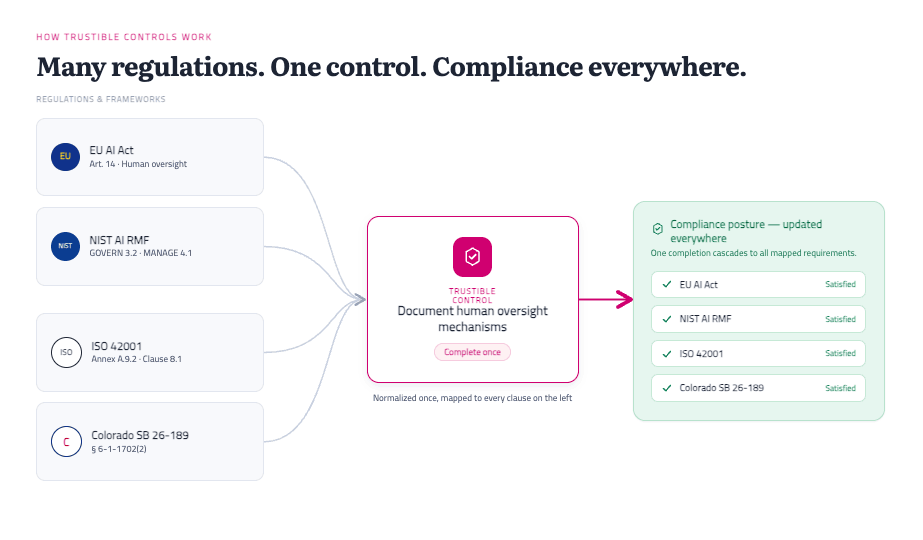
Your team documents human oversight for an AI system to satisfy the EU AI Act. Six months later, the governance team determines the ISO 42001 framework is relevant. The team finds the same requirement, worded differently. The documentation you already wrote doesn’t carry over, so someone rewrites it.
Same documentation, unique frameworks resulting in multiple tasks addressing the same information. All describing the same governance work.
The frameworks aren’t the problem. Tracking each one article as if it invented its own set of requirements is.
What’s new
Trustible Controls give you a single, normalized set of governance requirements that map across every framework you track, at once. Instead of a checklist per regulation, you get one control, like documenting human oversight mechanisms, mapped to every article and clause it satisfies across the EU AI Act, NIST AI RMF, ISO 42001, Colorado SB 26-189, and more. Complete the control once. Your compliance posture updates everywhere it applies.
Controls plug directly into the parts of Trustible you already use: your use case inventory, your model cards, your documentation fields, your policy library. There’s no separate system to maintain alongside them, allowing Governance teams holistic management of their program.
How it works
Control structure
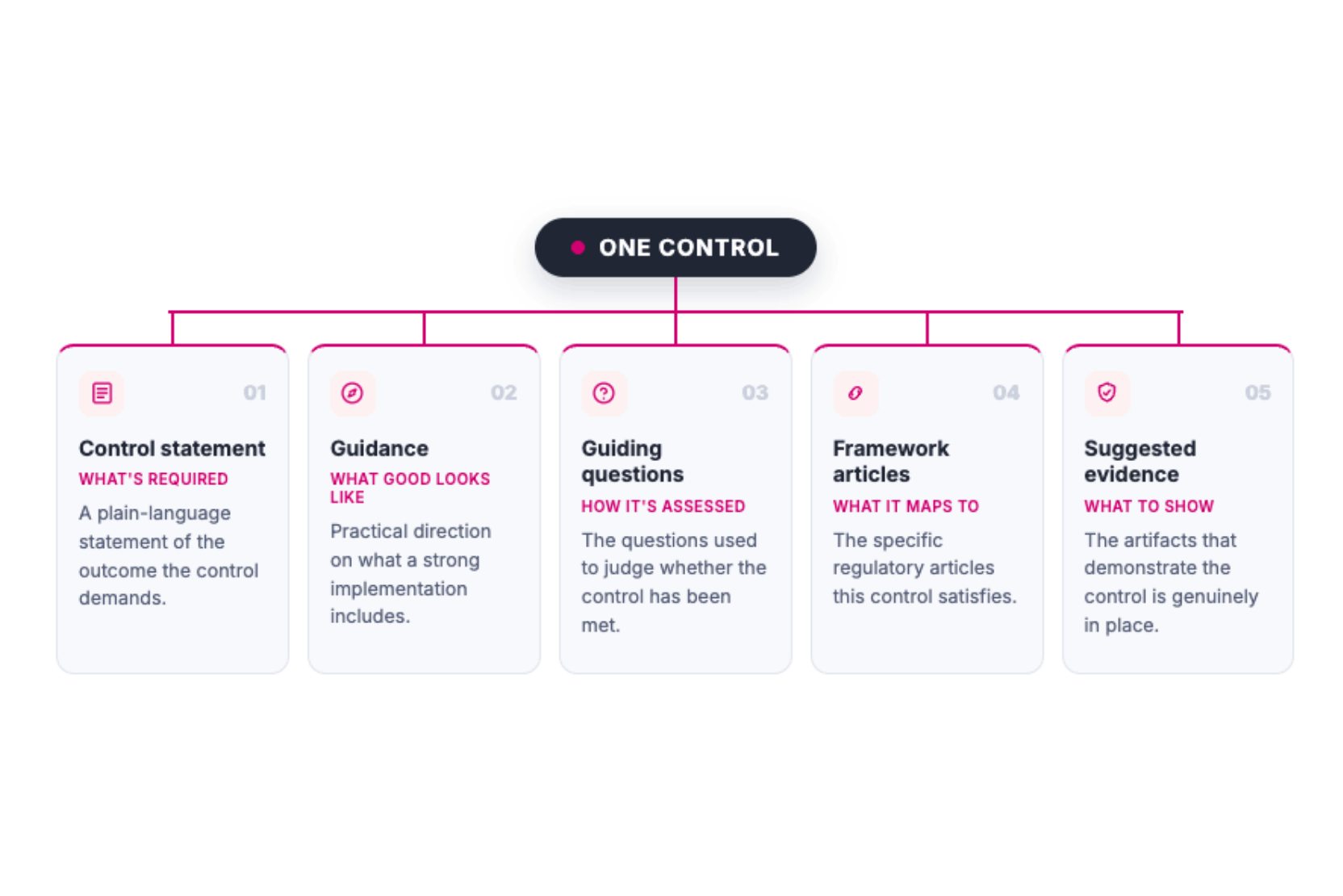
Controls can have five parts: a control statement describing what’s required, guidance on what a good implementation looks like, guiding questions used to assess whether it’s been met, the specific framework articles and designations it maps to, and suggested evidence. You get the level of detail you need without losing the rollup to the broader governance area – one control is a requirement that shows up across a dozen different regulatory checklists.
Control types
Controls are not only a function of use case documentation, they represent the ability for organizational wide compliance satisfaction. Controls are organized by the function they represent, not by which regulation they came from. This allows teams to look at their AI Governance program cross-functionally and holistically. Controls categories include: Organizational Policy, Workflow, Use Case Documentation and Transparency, and Model Documentation and Evaluation.
Control Satisfaction
Trustible’s AI for governance will assess control satisfaction so teams can focus on completing outstanding controls rather than reviewing control documentation for completeness. You’ll know exactly what kind of action satisfies a control before you start.
Designations
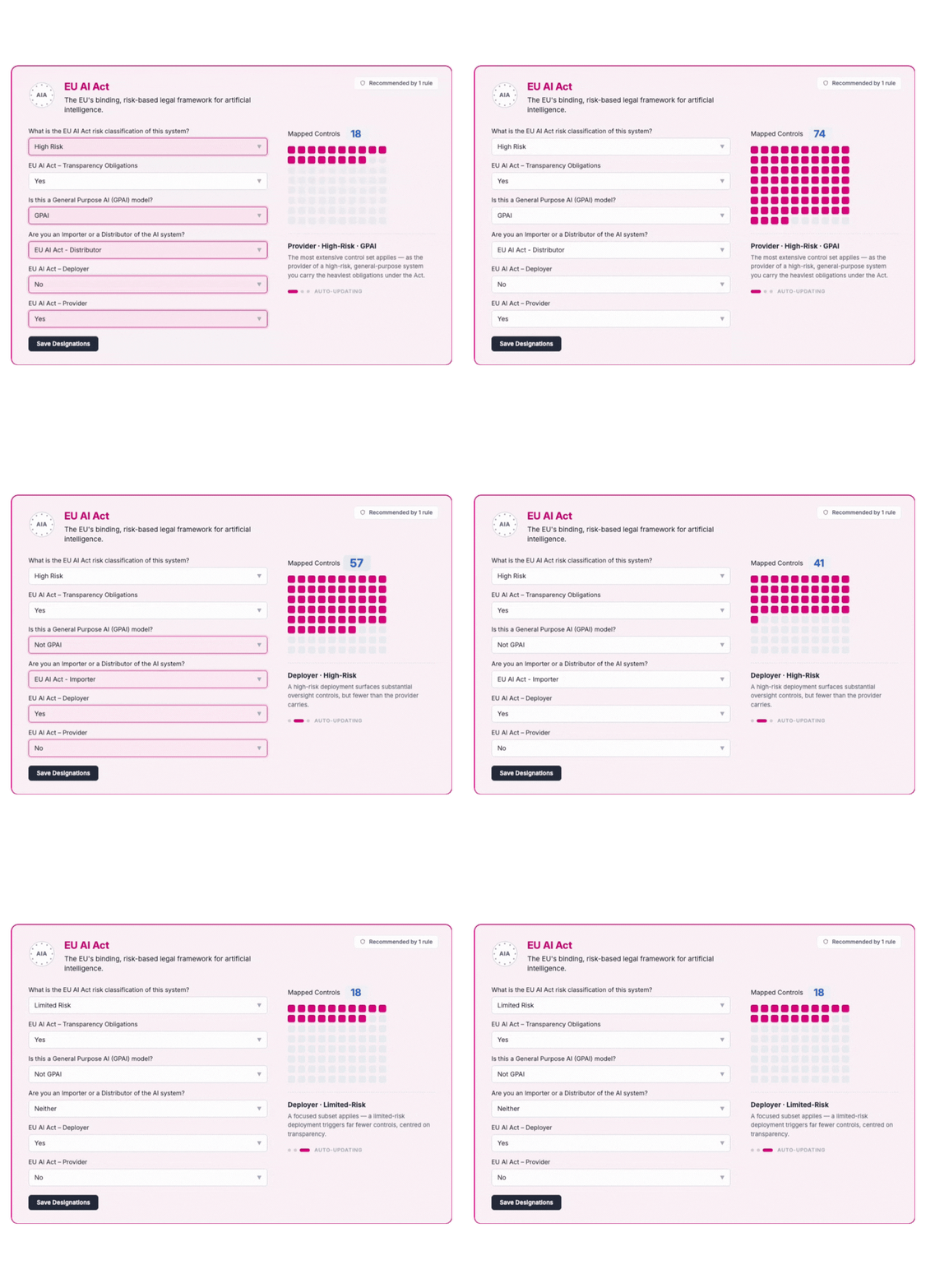
One major operational challenge with many AI governance frameworks is that they have a lot of conditional requirements. The best example of this is the EU AI Act, which outlines several buckets of systems, including high risk AI use cases, systems with transparency obligations, and general purpose AI models. Trustible treats these as ‘designations’, explicit attributes assigned to each use case that share which controls actually apply.
Designations are attributes you assign to a use case, like High Risk, Provider, Deployer, or GPAI under the EU AI Act, and they determine which controls actually apply. Teams see only the controls relevant to that use case, not a generic list padded with requirements that don’t apply. As your portfolio grows, designations ensure that each new use case gets the right set of controls automatically, based on its own risk profile and role
Why this matters now
Regulatory frameworks aren’t complementary, they’re often overlapping. The EU AI Act didn’t replace NIST AI RMF and ISO 42001 didn’t replace Colorado’s insurance AI rules. Most governance teams now track four, five, or more frameworks at once, and every new one adds another layer of requirements that overlap heavily with what’s already there.
Integrating framework compliance with use case inventory management means your effort scales with the number of regulations you’re subject to. Regulators are focused on the evidence a requirement is met, and teams should be focused on governance, not tracking evidence on four separate occasions.
What you’ll see
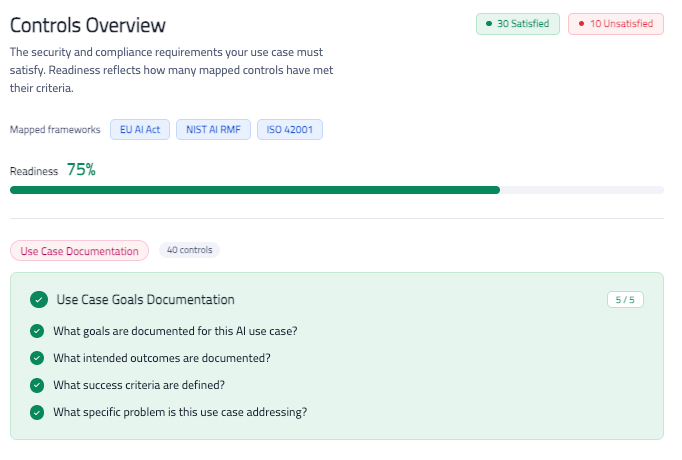
Organization-wide controls, policy and workflow, live on the Controls page, with a clear status for each: satisfied, in progress, or needs attention. Use case-level controls appear directly inside each use case’s detail view, scoped automatically to that system’s frameworks and designations. Every control shows the specific evidence behind it and the exact framework articles it maps to, so when someone asks which requirements a use case has met, you’re looking at a record, not assembling one.
Where this fits in the platform
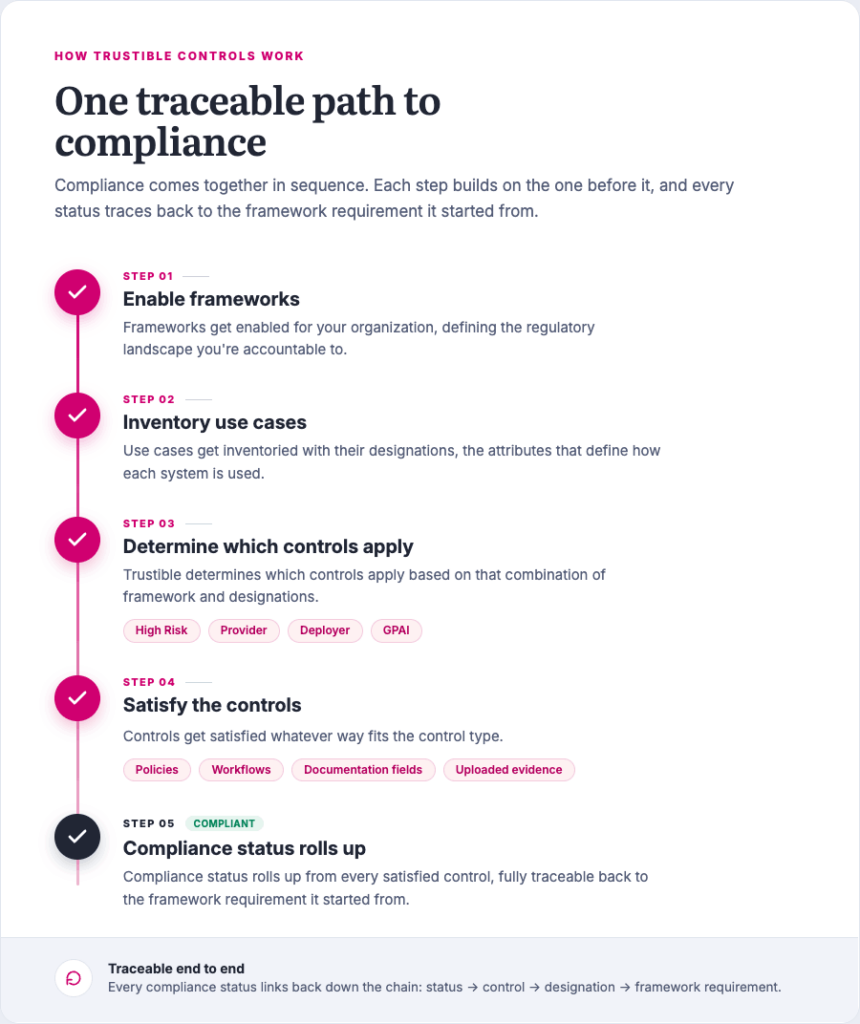
Frameworks get enabled for your organization. Use cases get inventoried with their designations. Trustible determines which controls apply based on that combination. Controls get satisfied through policies, workflows, documentation fields, or uploaded evidence, whatever fits the control type. Compliance status rolls up from there, fully traceable back to the framework requirement it started from.
What changes for your functions
Compliance: Instead of spreadsheets, you work from a group of controls aligning across multiple frameworks. Policy controls check your existing AI policies against guiding questions automatically, so you find gaps before an auditor does.
AI Governance: You see exactly which controls apply to which use cases and why, without manually cross-referencing frameworks.
Business Units: You fill in documentation once, in the use case record or model card you already maintain, and it counts as evidence across every framework that requires it.
Closing
Regulations will keep stacking. The work underneath most of them won’t change nearly as much as the language describing it. Trustible’s Controls let you track the work once and let the frameworks catch up to it automatically.
Frequently asked questions
Controls represent requirements of a framework that allow teams to align their AI governance program and use cases to multiple standards and regulations. They serve as the evidence you show customers, stakeholders, and regulators that your enterprise is implementing AI responsibly. Mitigations, by contrast, are use-case-specific measures that business stakeholders implement to address risks identified for their particular AI application. Controls and Mitigations may overlap as some frameworks can be very prescriptive about specific risks and risk mitigations practices that should be implemented, while other frameworks simply mandate broad ‘risk management’ functions without being specific.
Trustible’s team of AI policy experts maps each control to the specific framework articles it satisfies. This mapping is fully transparent within the platform, including the justification, explanation, and determination behind each satisfaction criteria. You can review all framework articles and their corresponding controls directly in Trustible.
Trustible’s Controls let AI governance teams scale compliance through a single, normalized set of requirements that map across every framework you track. Rather than managing a separate checklist for each regulation, you document one control (e.g., human oversight mechanisms) and it automatically maps to every relevant article across the EU AI Act, NIST AI RMF, ISO 42001, Colorado SB 26-189, and more. This standardization frees your governance program to focus on strategic priorities instead of manual compliance tracking.