As organizations increase their adoption of AI, governance leaders are looking to put in place policies that ensure their AI deployment aligns with their organization’s principles, complies with regulatory standards, and mitigates potential risks. But where to start in developing your policies can oftentimes be overwhelming.
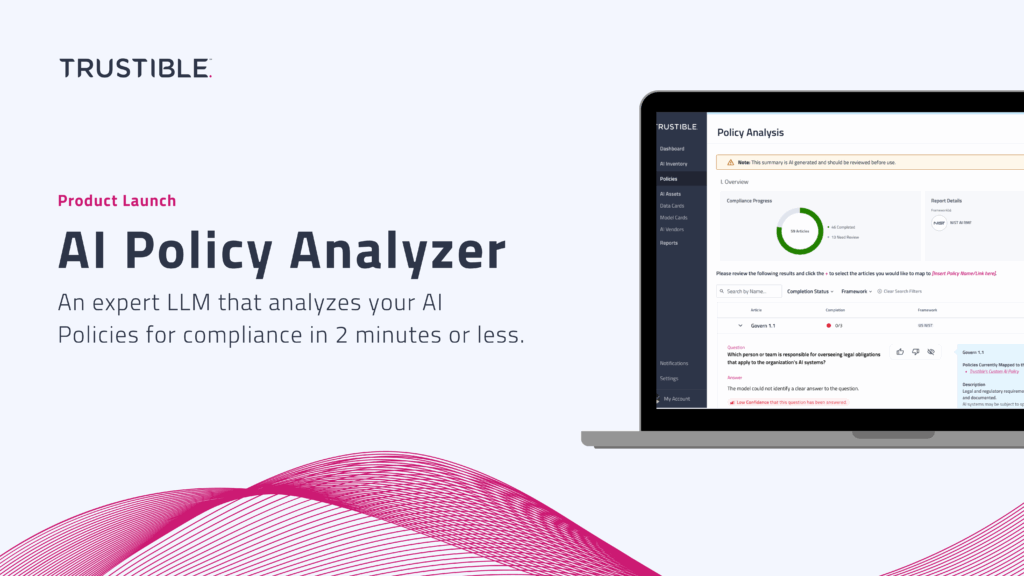
Product Launch: Trustible’s AI Policy Analyzer
For enterprise AI leaders and governance experts, developing Policies to guide the appropriate use and risk mitigation of AI can be a daunting task. Moreover, understanding whether that policy is compliant with AI regulations and standards can be costly, time-consuming, and overwhelming. Trustible’s AI Policy Analyzer is an expert AI system designed to simplify this process, providing an automated analysis of your existing AI policies in just minutes.
Everything you need to know about Colorado SB 205
On May 17, 2024, Colorado Governor Jared Polis signed the Consumer Protection for Artificial Intelligence (SB 205) into law, the first comprehensive state AI law that imposes rules for certain high risk AI systems. The law requires that AI used to support ‘consequential decisions’ for certain use cases should be treated as ‘high risk’ and will be subject to a range of risk management and reporting requirements. The new rules will come into effect on February 1, 2026.
Enhancing the Effectiveness of AI Governance Committees
Organizations are increasingly deploying artificial intelligence (AI) systems to drive innovation and gain competitive advantages. Effective AI governance is crucial for ensuring these technologies are used ethically, comply with regulations, and align with organizational values and goals. However, as the use of AI and AI regulations become more pervasive, so does the complexity of managing these technologies responsibly.
How State Executive Orders are Shaping U.S. AI Policy
States continue to pave the way forward on AI policy. As we have previously discussed, 2023 saw a flurry of activity from state legislatures on various AI-related legislation. However, state legislatures were not alone in attempts to implement greater oversight for AI technologies. Over the past year, the Governors of California, Maryland, New Jersey, Oregon, […]
Is it AI? How different laws & frameworks define AI
The race to regulate AI is promulgating an array of approaches from light-touch to highly prescriptive regimes. Governments, industry, and standards-setting bodies are rushing to weigh-in on what guardrails exist for AI developers and deployers. Yet, often times the regulatory conversations take for granted the answer to one fundamental question: What is AI? At its […]
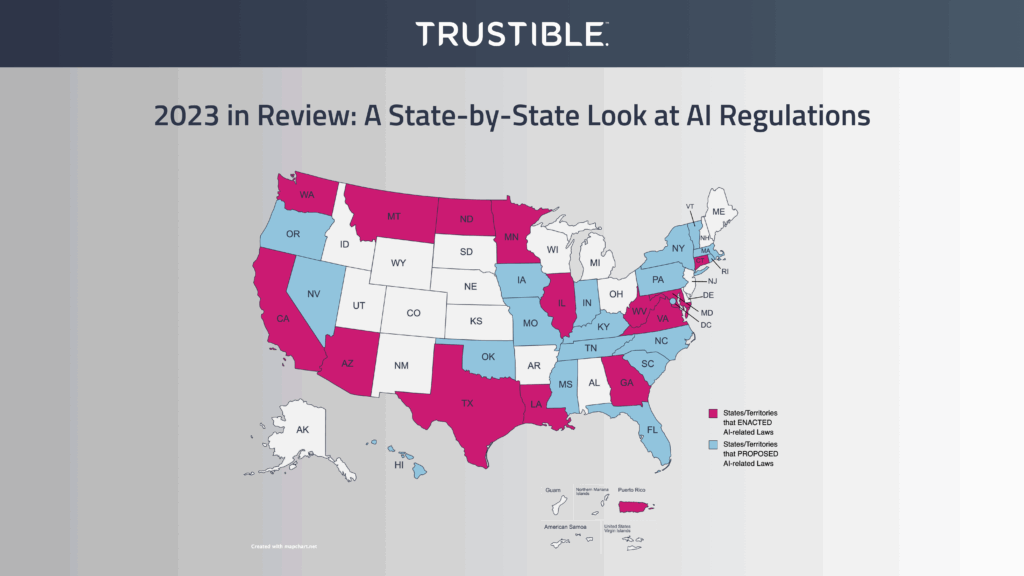
2023 in Review: A State-by-State Look at AI Regulations
In November 2022, Chat GPT brought the AI revolution straight into the hands of everyday consumers. However, if 2022 launched the proliferation and democratization of AI technology, 2023 can be remembered as the year in which policymakers tried to reign in AI. In the U.S., every branch of the federal government has weighed in on […]
Life After the Rite Aid Order: A Discussion on How the FTC is Shaking Up AI
AI incidents can have major implications for companies looking to develop and deploy AI. Oftentimes, organizations can be financially or reputationally harmed if the AI system performs harmful or unintended actions impacting people – furthering the need for hashtag #AIgovernance. The American drugstore chain RITE AID was recently banned by the Federal Trade Commission (FTC) from using AI facial recognition […]
How does China’s approach to AI regulation differ from the US and EU?
Artificial intelligence and geopolitics go hand in hand. On Thursday, July 13th 2023, the Cyberspace Administration of China (CAC) released their “Interim Measures for the Management of Generative Artificial Intelligence Services.” In it, the Chinese government lays out its rules to regulate those who provide generative AI capabilities to the public in China. While many […]